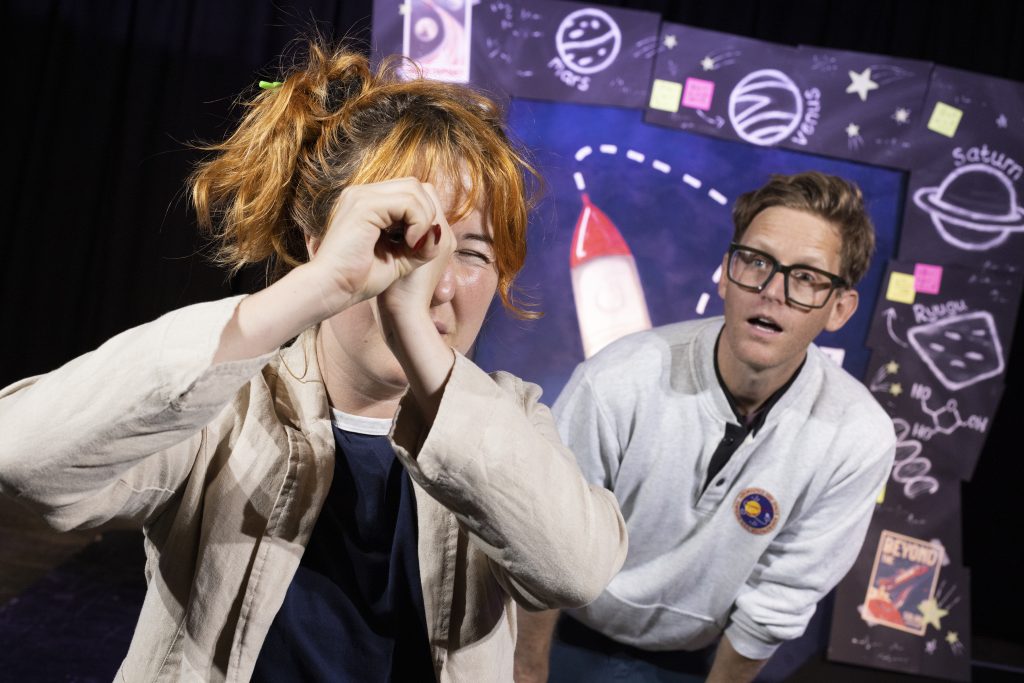
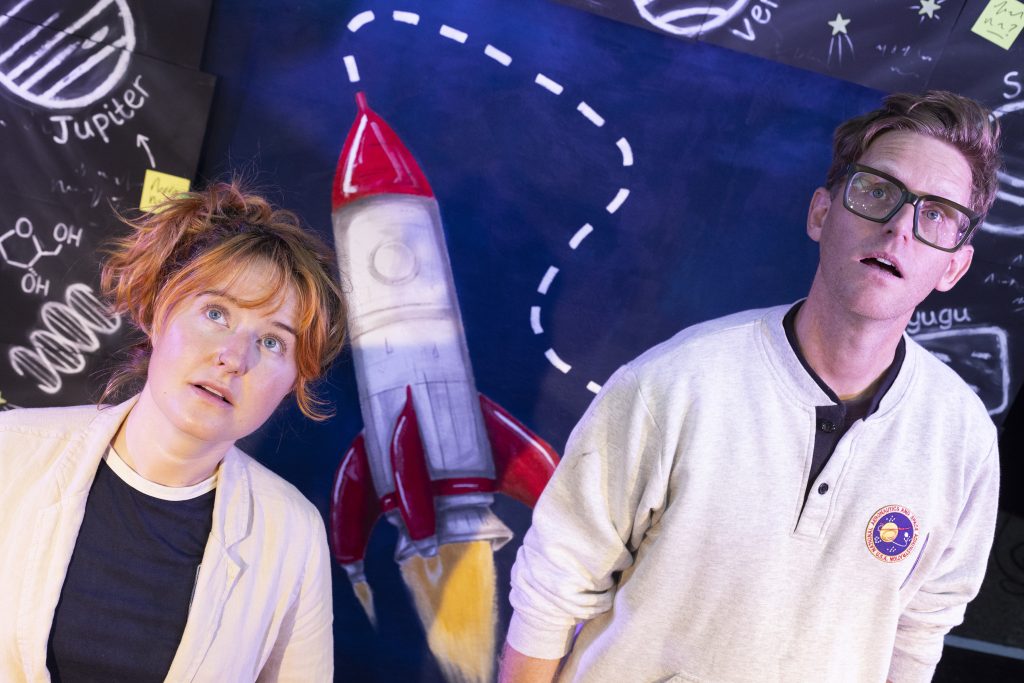
A few years ago, we found ourselves talking to some space philosophers (yes, that’s a thing).
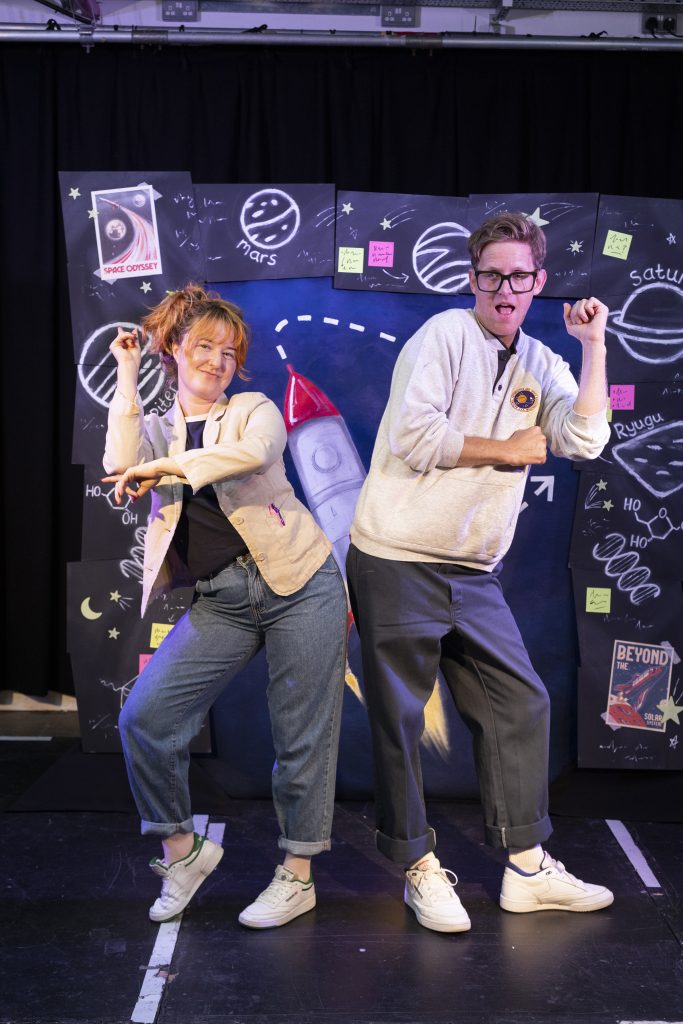
The conversation turned to one of the biggest questions humans have ever asked: are we alone in the universe? If there is life out there, what might it look like? And what would discovering it tell us about ourselves? Those conversations stayed with us and eventually became the starting point for Mission Outer Space – our new interactive show for 4–7 year olds, created in collaboration with Professor Robert Pal (Durham University) and Dr Lewis MacKenzie (University of Strathclyde).
The show premieres at Northern Stage this September before heading into schools later in the autumn.
When people think about life beyond Earth, it’s often aliens with eyes, arms and legs that spring to mind. But that’s not where Mission Outer Space begins.
” Our connections at Durham University introduced us to chemistry researchers who think about what life in outer space might be like” says our Artistic Director, Brad McCormick.
“So much popular culture about space is centred around aliens that have bodies and brains and are fully formed creatures. I like that we’re looking at this in a different way, zooming into molecules to search for evidence of living things.”
It’s a way of exploring space that feels both imaginative and grounded in real research. For Professor Robert Pal, who has spent years sharing his research with audiences of all ages, that’s exactly what makes projects like this worthwhile.
“Publishing in scientific journals for the scientific community is one thing,” he says. “Getting your work and your message to the public in a completely different tailored form is extremely rewarding and exciting.”
For Dr Lewis MacKenzie, it’s the biggest question science can ask.
“‘Are we alone in the universe?’ is the number one question for science,” he says. “As working scientists, we’re often focused on practical research, small details and applying for funding. Thinking about life beyond Earth is different. It’s big, inspiring and fun.”
“There’s a reason it’s the subject of so many stories, from Star Trek to Arrival. Mathematically speaking, we’re probably not alone in the universe, so the question becomes: where is that life, and how might we find it?”
Creating Mission Outer Space has been a genuine collaboration between theatre-makers and scientists.
“I’ve really had to lean into the scientists’ expertise,” Brad says. “For me, as a complete layperson, it feels like quite complicated chemistry that they’re looking into and they’ve been super helpful (and patient) in explaining it to me.”
As those conversations developed, they didn’t just shape the science in the show – they shaped the story too.
“Their research drives the narrative at the beginning of the workshop,” Brad explains. “It’s made me think more deeply about what kind of life there might be out there in space. If we aren’t alone, the immediate question might be, ‘What do these aliens look like?’ A different question could be, ‘Are these aliens biologically and chemically similar to us?’ Whether the answer is yes or no has some really fascinating ramifications.”
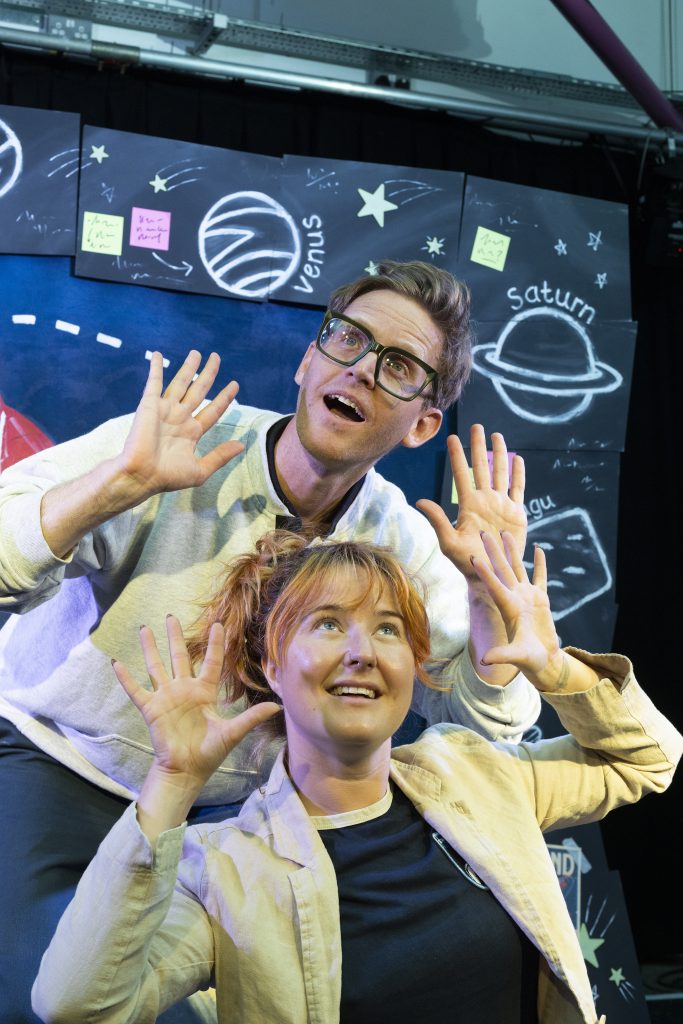
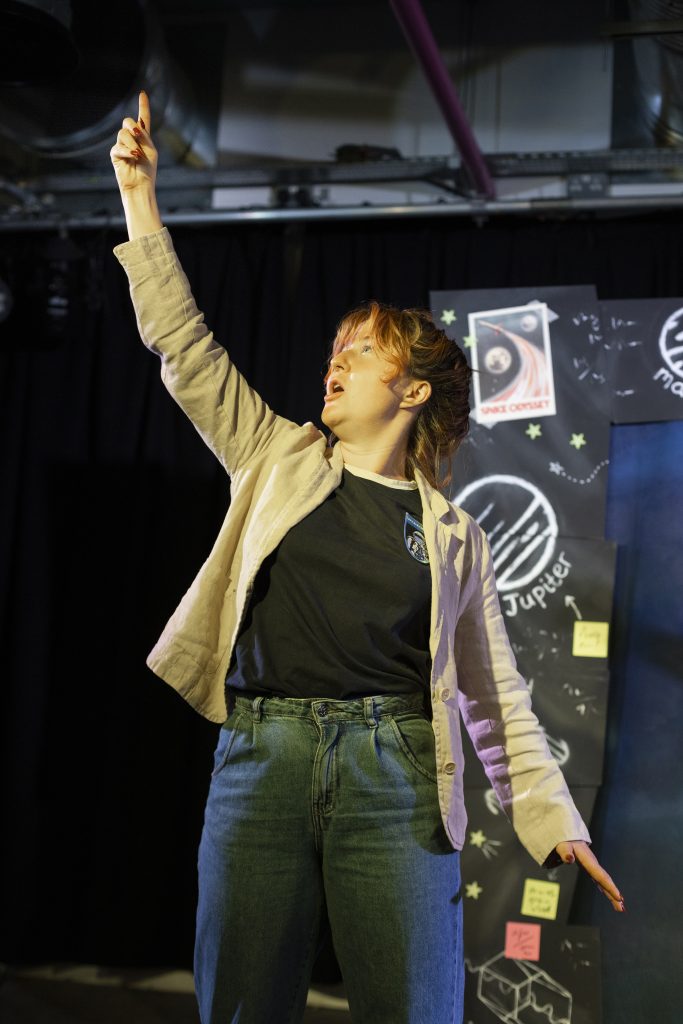
The collaboration has worked both ways.
“Working with Cap-a-Pie enables us to think about science communication in new and exciting ways that we, as scientists, are not generally equipped to do by ourselves,” says Dr Lewis MacKenzie.
Professor Pal agrees. “It has been an absolute pleasure working with Cap-a-Pie. It is always people who aren’t involved with the underlying science from the start who ask the best questions we never thought of.”
Children are naturally curious about space, which made it an exciting place to start.
“Young people are so interested in space,” says Brad. “We felt like we’d have a head start because it’s a subject they’re already keen on.”
But alongside the adventure, there’s real science to discover. One of the ideas explored in the show is chirality – the concept of mirror images. It’s an important tool scientists use when investigating whether life might exist beyond Earth.
“Probably the most exciting part of creating the show was the moment where, after trying several times, I was eventually able to succinctly explain chirality to someone. Once you can do that, you start thinking, ‘Actually, I can distil this down so young children can get their heads around it.'”
What do we hope children will take away? For everyone involved, the answer goes beyond facts and figures.
“I would love for children to come away being excited about science and how it’s looking for signs of life in space in these really amazing ways,” says Brad. “And even to think about the big question of ‘Are we alone in the universe?'”
Dr MacKenzie hopes children leave with a sense of just how broad science can be.
“I hope children will learn that science spans the universe from the smallest molecules to humans – or aliens! I also hope they see that science isn’t always split neatly into biology, physics and chemistry, and that science is fun.”
Professor Pal agrees, adding: “Most importantly, I hope they ask questions. Some of them will embark on a mission to find some answers. Whilst doing it, they’ll learn even more.”
Like many Cap-a-Pie projects, Mission Outer Space isn’t simply a theatre show or a science workshop.
“It’s a hybrid of both,” says Brad. “There are moments where the audience are watching and listening, and a big part where they’re up and moving around, using their imaginations with us.”
“As it’s made for 4–7 year olds, we’ve woven the science through everything we do and really tried to put it across in a way they can understand. In some ways, they might not even know they’re learning about science!”
Mission Outer Space premieres at Northern Stage on 26 September, before travelling into schools from autumn 2026. We can’t wait to start asking these big questions with young audiences.