
Childhood is our newest project for schools and it started with a couple of simple questions: what does it mean to be young in 2026? And how does that compare to what childhood looked like 150 years ago?
The project came together after a conversation with a Year 1 teacher about parts of their curriculum that might benefit from drama and creativity. They mentioned the history of toys covered in KS1. Around the same time, we spoke to some Year 2 students about what they care about and the ideas of power and agency kept coming up – that they didn’t feel they had a lot of either. Those two threads, pulled together under the question of what it means to be a child today, felt like a really good fit.
We also have a relationship with Dr Laura Tisdall, a historian at Newcastle University who researches the history of childhood. She worked with us to develop the project and came into one of the workshops with the children, which made a real difference.
What happens in the workshops
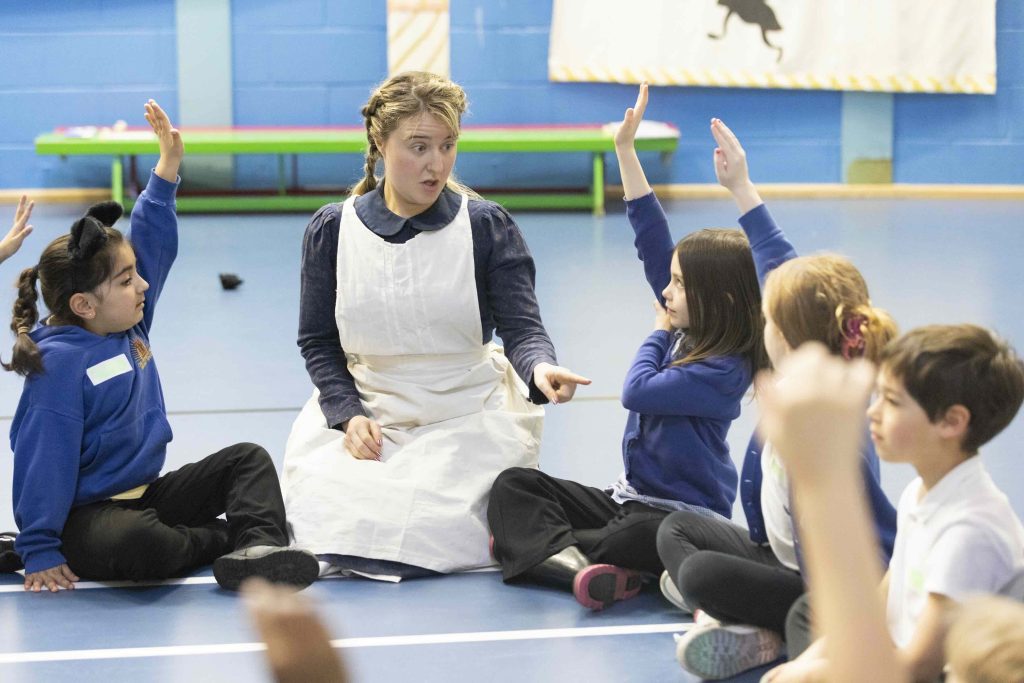
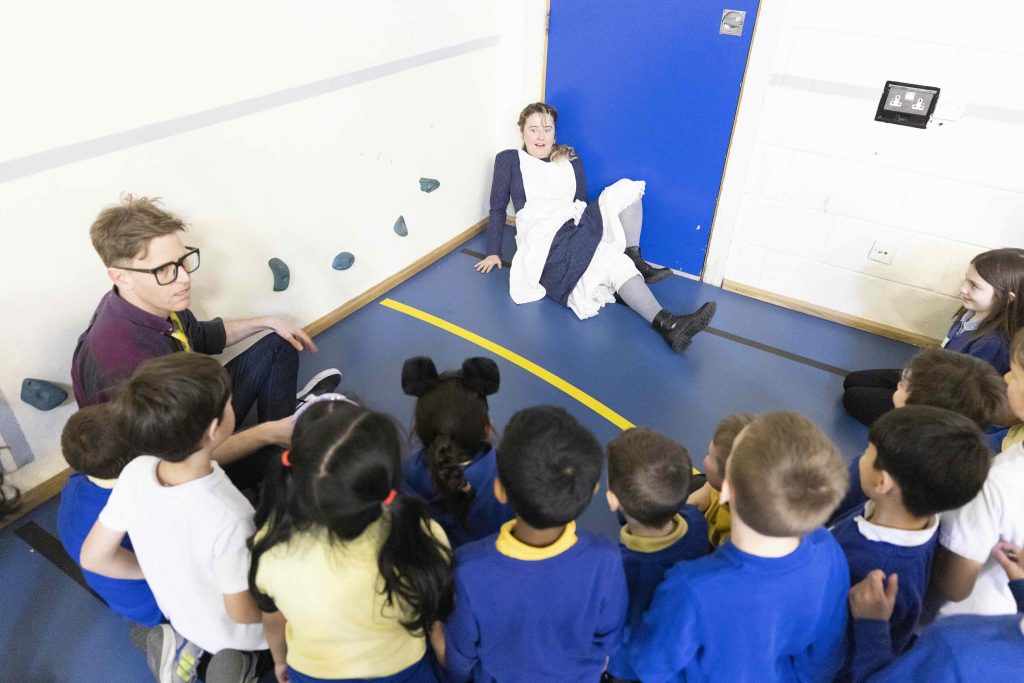
Children come into the hall at their school to find a person lying on the floor, seemingly asleep. When they wake her up, she reveals that she’s from 1875. She’s somehow travelled through time to 2026, and now that she’s here, she would love to know what it’s like to be a child at this moment in history.
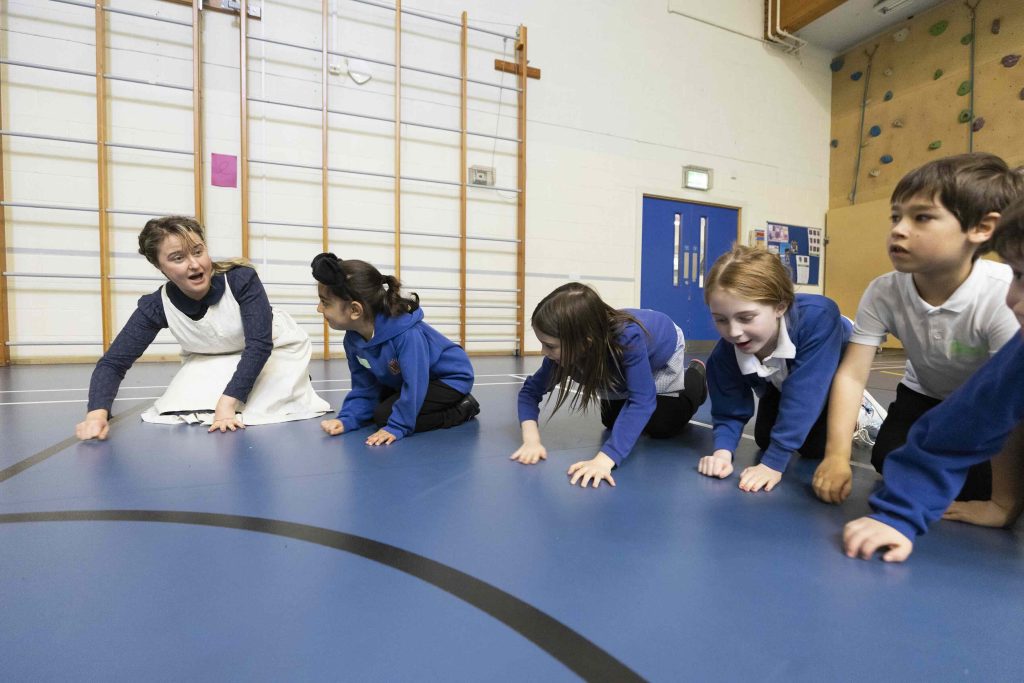
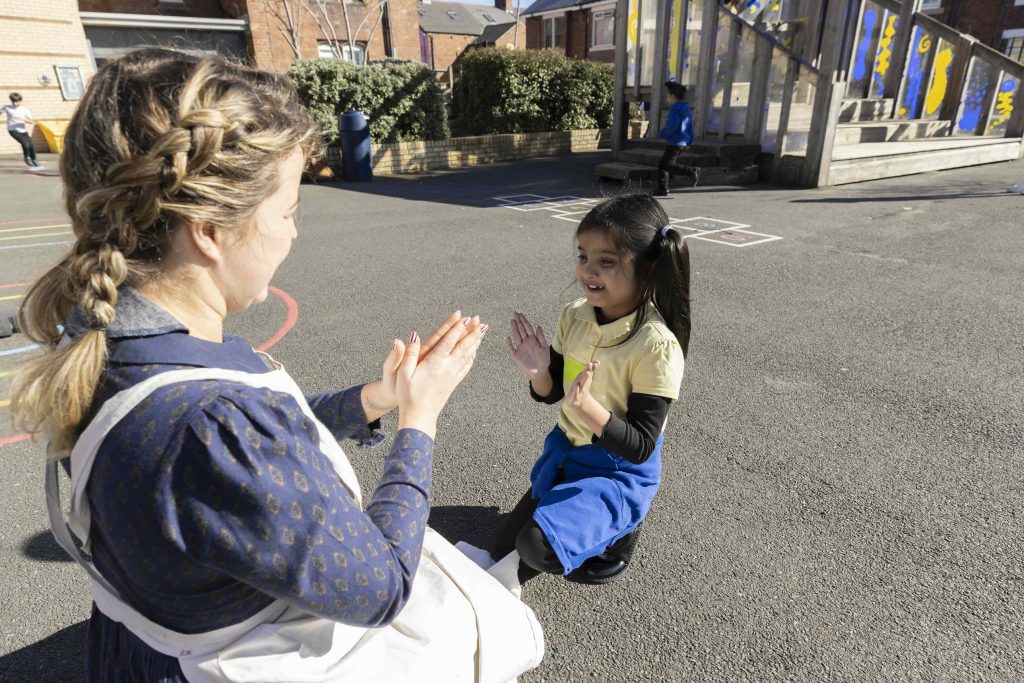
What follows is an exchange. The children show her their classroom, she shows them Victorian games and they learn about what childhood looked like for some children 150 to 200 years ago – including the fact that for many, paid work was a large part of daily life, whether that was running errands, working in shops or even down the mines. Stories about the stranger jobs – like a ‘bonegrubber’, who would collect animal bones to sell to glue factories – went down particularly well.
The workshops also touch on Victorian schools, which are quite different from today. One exercise involved getting students to stand up whenever their teacher left or came back into the room and address them as “yes, ma’am” or “no, sir”.
The character: Elizabeth Brown
The Victorian child is played by facilitator Jeannie, who stays in character as Elizabeth throughout the workshop. Here’s how Jeannie describes her:
“Elizabeth Brown is an 11-year-old working-class girl living in Byker, Newcastle in 1875. She is the eldest of eight children and works as an errand-girl to help support her family after her father lost his job at the Ouseburn Engine Works. She is practical, responsible and used to adult responsibilities from a young age. Elizabeth is busy, observant and street-smart from running errands across the city, but she is also curious and quietly ambitious. She enjoys learning at the ragged school and hopes education might give her a chance of a better life than casual labour. Her childhood is shaped by overcrowded housing, poverty, illness and constant work, but she still has moments of play and imagination when she is with other children in the streets.”
Stepping into that role turns the usual classroom dynamic on its head – it puts the children as the experts. They were the ones who knew how a tap worked, what a TV was, what a water bottle was. Several took it upon themselves to guide Elizabeth around the classroom and point out things she had “never seen before.”
As Jeannie put it: “The children responded with high levels of belief and emotional engagement, treating the character as real and asking thoughtful questions about her life. They were also incredibly welcoming and kind – they invited me into their play, asked me to join their games and were keen for me to be part of their classroom community.”
What the children made of it
The games stood out for most of the children – things like Heads Down Thumbs Up and Duck Duck Goose. One child mentioned they particularly enjoyed the free play section. There was also one child who said they didn’t really like Drop the Handkerchief – a Victorian parlour game that has evolved into Duck Duck Goose which was interesting in itself.
The freeze-frame activity, where children interpreted pictures of Victorian children working in the mines, was a highlight. Jeannie said that they showed “a remarkable ability to convey emotion, posture, levels, imagination and creativity.”
The teachers’ observations picked up on how well the children were able to empathise with children their own age whose lives looked completely different. As one teacher said: “Children were definitely able to empathise with children their age whose lives were completely different in the past and consider what that could have been like if they were in the same situation. Particularly when considering the jobs children used to do.”
Why we built it around plan
One of the things that became clear early on was how central unstructured play already is to a KS1 school day. A consistent part of the children’s routine is ‘choosing time’, where they can go to one of the areas in the classroom and play how they like, whether that’s with play-doh, colouring or building blocks. Building a workshop around play made a lot of sense.
For older age groups, games often come in as part of the learning. In Childhood, the game essentially is the Elizabeth situation – the fictional scenario of meeting someone from 1875 and having to explain your world to them. Brad, our Artistic Director says:
“In one of the first workshops I asked the children ‘what do you do when you run out of things to play?’ and one student just said ‘my brain comes up with something else!’ We know play is important for children, but because much of it is improvised and fluid, it feels like there’s a lot of mystery to it, and it was great to witness unstructured play and dig into what was happening.”
Jeannie noticed something else in the comparison between then and now: that where Victorian games relied on imagination, physical movement and social interaction, a lot of children’s play today is shaped by toys or technology. It’s a small observation but it says something bigger about how the world children grow up in finds its way into how they play.
There’s also something unique about the way the facilitation works. What’s distinctive about this project is that it combines one facilitator fully in-role (as Elizabeth) with another facilitator being themselves. The facilitator not in character can pretend to experience Elizabeth’s arrival with the same surprise as the students and act as a bridge between them and her, guiding the class at the start and then stepping back to let the relationship develop.
There’s a moment that keeps coming up when we talk about this project. The children, absolutely convinced they’re talking to someone from 1875, taking it upon themselves to explain what a hoover is, to someone who has never seen one.
It’s funny, but it’s also something more than that. The children weren’t just playing along, they genuinely wanted Elizabeth to understand their world, in the same way the workshops asked them to try to understand hers. That instinct, to bridge a gap and bring someone in, is probably the best thing a drama project can hope to unlock.
We delivered Childhood again in March with a Year 2 group and we’re already thinking about where it goes next.